Dulini Moya

A Slow Stay

Dulini Moya

Sabi Sand, South Africa

There are safari camps that impress you and safari camps that undo you. Dulini Moya is the latter. Tucked into a fig forest above the Moya River in the southern Sabi Sand, it is one of the smallest and most intimate camps in the reserve — five suites, one guide per vehicle, and a stillness after dark that makes you understand why people come back year after year.

The Sabi Sand has unfenced boundaries with Kruger National Park, which means the wildlife moves freely and in extraordinary numbers. Leopards here are so habituated to vehicles that they will walk past within arm's reach. Elephants drift through camp in the afternoon heat. At night, from the deck of your suite, you hear the bush as it has always sounded — unchanged, unhurried, entirely itself.

The Suites

Five suites built into the tree line, each with a private plunge pool and an open-sided deck that faces the river. The interiors are warm and pared back — stone floors, teak furniture, gauze curtains that move in the evening breeze. There is no glass between you and the bush. You fall asleep to sounds you cannot quite name and wake to the slow gathering of birdsong before first light. It is designed to be comfortable without feeling insulated from the place you came to experience.

The Main Area

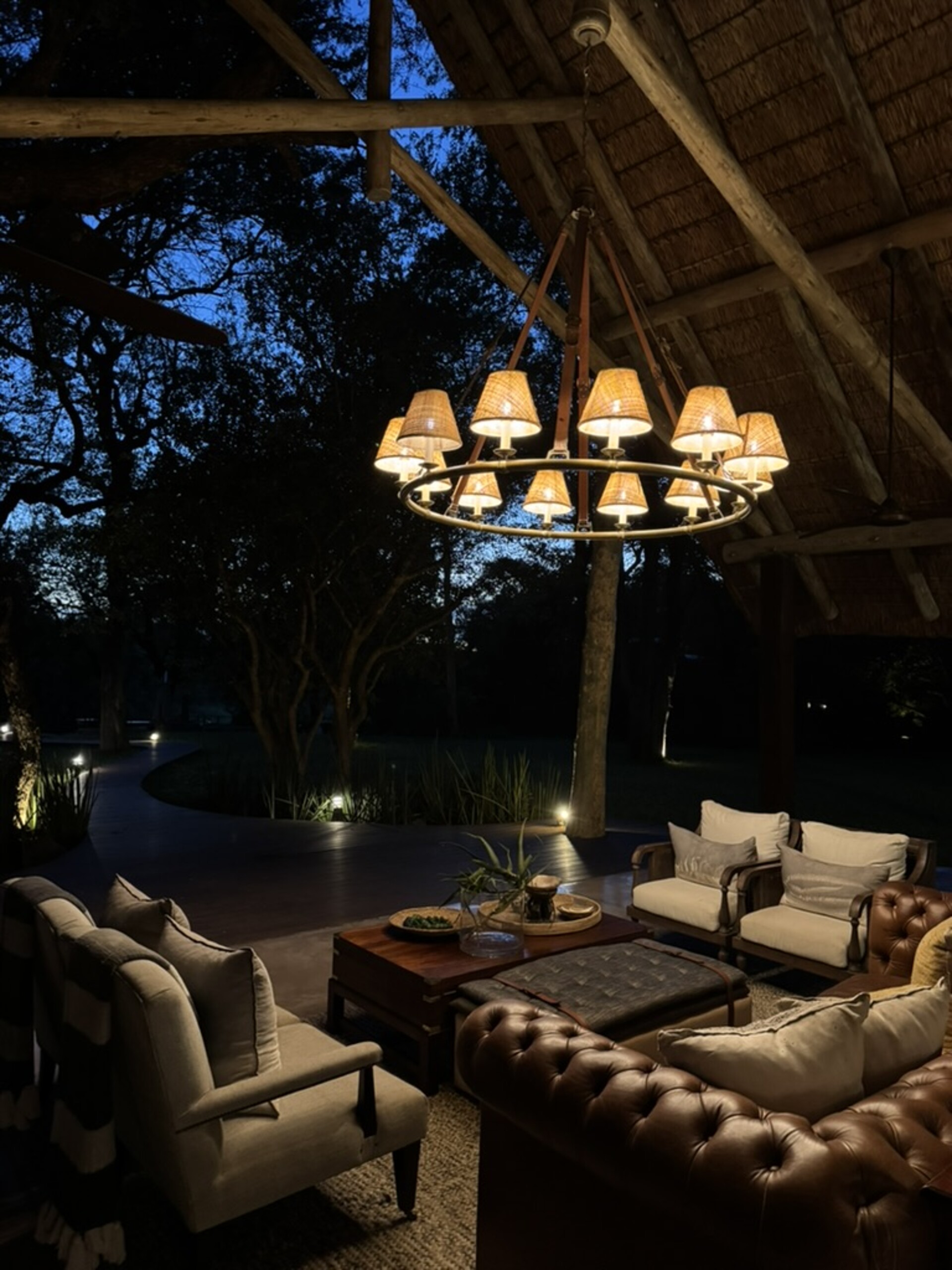
A thatched open-sided lounge and dining area built around the natural contours of the riverbank. At night it is lit by firelight and the cluster of pendant lanterns above the central sitting area — leather sofas, worn timber, the kind of space that makes a long evening feel natural rather than forced. Meals are served here or, on clear nights, in the open boma under a sky dense with stars. The food is excellent; the wine list considered. The rhythm of meals and drives structures the day without constraining it.

The Guiding

Two drives a day, morning and afternoon, with a ranger and tracker in an open vehicle. The tracking at Dulini is exceptional — the Moya River valley produces consistent leopard sightings, and the southern Sabi Sand has one of the densest populations of lion and elephant in the reserve. But the quality of the drive is about more than what you see. The guides here know how to read the bush — the direction a bird call comes from, the age of a track, what a broken branch tells you about something that passed in the night. You come back from drives knowing more than you did when you left.

Brendan & Observer

We were fortunate enough to have Brendan as our guide and Observer as our tracker, and the two of them are, without question, the finest team we have encountered anywhere in Africa. Their dynamic in the field is something to watch — quiet signals, a shared instinct for where things are moving, an almost wordless communication built over years of working the same ground together. Thanks to them, we saw the Big Five and then some: lion, leopard, elephant, buffalo and rhino, yes, but also pangolin, wild dog, hyena hunts, and encounters that most guests wait a lifetime for.

What set them apart was not just what they found, but what they taught us to see. Brendan has the rare gift of making the whole ecosystem legible — not just the big animals, but the role of the oxpecker on the buffalo's back, the dung beetle rolling its prize across the track, the leadwood tree that will still be standing in three hundred years, the fork-tailed drongo mimicking a jackal alarm call to steal a meal. Observer's ability to read tracks, soil and vegetation is extraordinary. He would crouch over a paw print in the sand and tell you which leopard made it, how long ago, and where it was headed. Every drive with them became a lesson in how everything connects, and how the bush — if you slow down enough to pay attention — is one of the most eloquent places on earth.

The River

The Moya River is dry for much of the year, but it remains a corridor for wildlife movement and a focal point for animal activity. Hippos hold water in the deeper pools. Crocodiles sun on the banks. In the early morning, before the heat comes, the river bed is crisscrossed with tracks from the night before — a record of everything that passed while you were asleep, written in the sand and readable to anyone who knows how to look.

The Sabi Sand Reserve

One of Africa's oldest and most celebrated private game reserves, sharing an unfenced border with Kruger National Park across more than 65,000 hectares of bushveld. The wildlife density is exceptional — the Big Five are present and, crucially, habituated to vehicles in a way that allows close, prolonged observation without disturbance. Leopard sightings in particular are extraordinary here; the Sabi Sand has the highest density of leopard of any reserve on the continent, and encounters are daily rather than occasional.

The Bush at Night

After the evening drive, the camp belongs to a different cast of characters. Hyenas move through. Genets appear on the roof beams of the main area. Hippos graze within earshot. The darkness in the Sabi Sand is total — no light pollution, no noise except what the bush generates itself. Lying in bed with the canvas walls open to the night, you become aware of how close the wild world actually is, and how briefly most of us are in contact with it.

Skukuza

45-minute drive

The main camp of Kruger National Park, a short drive from the Sabi Sand boundary. Worth visiting for the context it provides — the history of conservation in the greater Kruger ecosystem, the camp's own wildlife archive, and the sense of scale that only becomes apparent when you understand how the private reserves and the national park relate to each other. The drive there and back through the park is worthwhile in itself.

Do

  • Stay at least three nights — the bush reveals itself slowly
  • Wake early and get on the morning drive — the first hour of light is irreplaceable
  • Ask your tracker to explain what he is reading on the ground
  • Sit on the deck of your suite at dusk and let the sounds come to you
  • Switch your phone off for the duration — the bush demands your attention

Don't

  • Rush the experience by trying to see everything at once
  • Underestimate the cold — early morning drives in winter require serious layers
  • Skip the sundowner stop on the evening drive — gin in the bush at last light is non-negotiable
  • Leave before a night drive — the bush after dark is an entirely different world
  • Expect Wi-Fi — the disconnection is a feature, not a flaw