Menorca

A Slow Guide

Menorca

Hidden calas, stone walls & Balearic stillness

Menorca is the quieter Balearic — the one that resisted the noise. While its neighbours leaned into volume, Menorca turned inward, toward the land and the sea, and stayed that way. A UNESCO Biosphere Reserve since 1993, the entire island is protected: the coastline untouched, the interior woven with dry stone walls that have stood for centuries, the light falling clean and unhurried across farmland and pine forest alike.

The pace here is set by the water. Mornings are for walking coastal paths that lead to coves you won't find on any sign. Afternoons dissolve at the edge of some turquoise inlet, limestone cliffs rising on either side, the only sound the slow pull of the tide. Evenings belong to harbour towns where the stone turns gold at dusk and dinner doesn't start until the sun has fully gone. Menorca doesn't ask you to do anything. It simply rewards you for slowing down.

Cala Macarella & Macarelleta

South coast, near Ciutadella

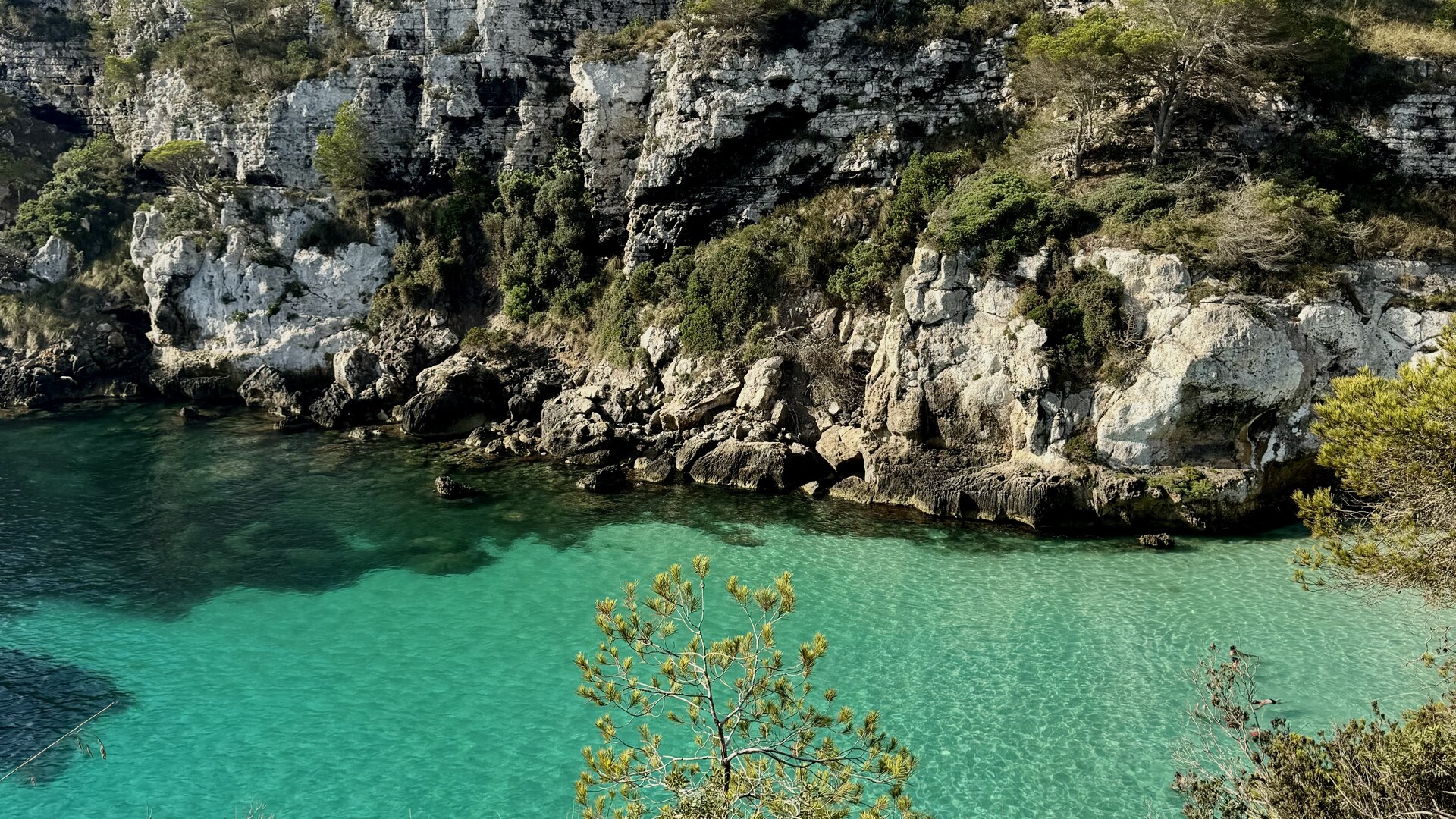
Twin coves of turquoise water framed by limestone cliffs and umbrella pines that lean toward the sea as if listening. Macarella is the larger of the two, a crescent of pale sand with water so clear it barely looks real. A short scramble over rocks brings you to Macarelleta — smaller, quieter, wilder. Arrive early in the morning before the day-trippers, spread a towel on the warm stone, and stay late. By five o'clock, the light turns the cliffs amber and you'll have the place almost to yourself again.

Ciutadella Old Town

Western tip of the island

Honey-coloured stone, narrow streets that twist without logic, palazzo doorways leading to courtyards you'll never see, and the cathedral square at dusk when the swallows circle and the last light catches the sandstone facades. Ciutadella was the island's capital for centuries and it carries that weight gracefully — a town that feels like it hasn't changed in hundreds of years and has no intention of starting now. Walk without a map. Get lost. Find a table in a quiet plaza and let the evening come to you.

Camí de Cavalls

The ancient coastal path, 185km around the island

The Camí de Cavalls is the old bridleway that circles the entire coast of Menorca — 185 kilometres of cliff-top trails, hidden beaches, pine forests and rocky headlands. Originally used by soldiers and horsemen guarding the coast, today it's divided into twenty sections, each walkable in a few hours. You don't need to do it all. Pick a section each day — the stretch from Cala Galdana to Cala Mitjana is particularly beautiful — and let the path lead you to places the roads never will.

Monte Toro

Centre of the island, 358m

The highest point on the island, crowned by a monastery and a statue of Christ that watches over the harbour towns below. On a clear day, the views stretch across the entire island — south to the white-sand calas, north to the wilder, wind-shaped coast, east to Mahón's harbour and west to the ochre rooftops of Ciutadella. It's a short drive or a longer walk through farmland and holm oak forest. Go early, before the heat builds, and bring something to drink at the top. The silence up here is its own kind of view.

Cala Pregonda

North coast

The red-sand beach on Menorca's north coast, reached only on foot — a thirty-minute walk through pine forest from the nearest road. The sand is the colour of burnt terracotta, the water shifts between deep blue and green depending on the hour, and strange weathered rock formations rise from the shallows like sculptures left behind by the tide. It's wilder and less visited than the south-coast calas, and worth every step of the walk in. Bring water, a book, and no expectation of phone signal.

L'Espiell

Ciutadella

A Ciutadella favourite for lunch — a bright, unpretentious room that fills quickly and earns its reputation without any effort. The cooking is rooted in the island: local fish, vegetables from nearby farms, dishes that are simple in the best sense of the word. Order the daily specials, eat slowly, and let the afternoon drift. The kind of lunch you plan around coming back for.

Cova d'en Xoroi

Cala en Porter

A bar built into the sea cliffs on the south coast, carved from natural caves that open directly onto the Mediterranean. Go for sunset drinks — the view is the thing. Perched on the edge of a sheer rock face, cocktail in hand, watching the sun drop into the sea while the sky turns from blue to copper to violet. Arrive an hour before sunset to find a good spot, and stay until the stars come out.

Torralbenc

Alaior

The restaurant at Torralbenc — a beautifully restored farmhouse hotel in the island's interior — is worth visiting even if you're not staying there. The cooking is considered and seasonal, rooted in the landscape surrounding the estate: vegetables from the kitchen garden, local cheese, fish from the Menorcan coast. The setting is extraordinary: a long, candlelit terrace looking out over the countryside, the silence broken only by the cicadas. Book for dinner and let the evening take its time.

Aquarium

Port of Ciutadella

A long-standing fixture on Ciutadella's working harbour, with tables right at the water's edge and a menu built entirely around what came off the boats that morning. The fish here is exceptional — grilled whole, simply dressed, allowed to speak for itself. Order whatever the waiter recommends, drink something cold and local, and watch the harbour do its slow, unhurried thing around you.

Cap Roig

North coast, near Fornells

One of Menorca's most legendary tables — a fish restaurant on the north coast that has been pulling people off the road for decades. The setting alone is worth the drive: tables on the rocks above a small cove, the sea directly below, the north coast light doing something spectacular to everything it touches. The menu centres on the day's catch: grilled fish, local lobster, whatever the sea offered that morning. Go for lunch when the light is at its best and the afternoon is yours to lose.

Son Blanc

Ciutadella

The restaurant at Son Blanc farmhouse is one of the finest meals on the island — farm-to-table in the most literal sense, with produce grown on the estate and a kitchen that treats its ingredients with real care. Dine on the terrace as the sun goes down over the Menorcan countryside, the fields quiet around you, a glass of something from the wine cellar in hand. It has the rare quality of feeling both special and unhurried at the same time.

Es Bruc

One of our favourite beaches

The perfect lunch spot — a chiringuito at one of the island's most beautiful beaches, the kind of place that earns its reputation purely by being exactly where it is. Cold drinks, fresh food, the sea directly in front of you. Note that arriving by boat sounds straightforward but isn't — the approach is trickier than it looks. Coming overland is the easier call. Worth every effort either way.

Sa Llagosta

Fornells

Fornells is the home of Menorcan lobster, and Sa Llagosta is one of the village's most respected tables for it. The caldereta de llagosta — the island's signature lobster stew, slow-cooked and rich with the flavour of the sea — is what you come for. Sit outside in the fishing village square, order the caldereta for the table, and take the whole afternoon over it. This is not a meal to rush.

Cantina

Ciutadella

One of the most enjoyable evenings in Ciutadella — a relaxed, convivial room that gets the balance right between atmosphere and food. The cooking is straightforward and well-executed, the wine list considered, and the crowd the kind that stays late. The sort of place that doesn't need a concept because the cooking and the company are already enough. Book ahead; it fills quickly for good reason.
Do

  • Rent a car with good clearance — the best calas need dirt roads
  • Walk at least one section of the Camí de Cavalls
  • Eat caldereta de llagosta at least once — it's Menorca's signature
  • Visit Ciutadella on a Saturday morning for the market
  • Stay on the south coast for the best swimming

Don't

  • Compare it to Mallorca or Ibiza — Menorca is its own island
  • Arrive at popular calas after midday in August
  • Skip the north coast — it's wilder, emptier and more beautiful
  • Expect everything to be open in the off-season — many restaurants close from November to April
  • Leave without watching a sunset from Pont d'en Gil