Dolomites

A Slow Guide

Dolomites

Alpine meadows, ancient rifugi & mountain silence

The Dolomites move on a different clock. Mornings are measured in summits gained before the world wakes, afternoons in the slow unfolding of a rifugio meal — canederli, speck, a glass of something local — eaten on a wooden terrace with nothing but rock and sky for company. Evenings belong to the alpenglow, that brief and unrepeatable moment when the pale limestone turns rose, then amber, then violet, and the mountains seem to breathe.

This is Südtirol, a place that exists at the seam of two cultures. The language shifts between Italian and German mid-sentence. The architecture swings from Tyrolean wood-panelled Stuben to Mediterranean terraces draped in wisteria. Strudel follows pasta. The bells on the cows are Austrian; the espresso is unmistakably Italian. It is a place that refuses to be one thing, and is richer for it — a landscape where every valley feels like its own small country, unhurried, particular, and deeply itself.

Seceda

Val Gardena

The ridgeline above Val Gardena is one of those landscapes that looks digitally altered until you stand in front of it. Jagged teeth of pale rock rising from impossibly green meadows, falling away to nothing on the far side. Come at sunrise, before the first cable car starts running, when the light is low and gold and the only sound is wind through grass. It is a view that earns its silence.

Tre Cime di Lavaredo

Sesto Dolomites

Three towers of vertical rock, ancient and immovable, standing like sentinels above a landscape of scree and sky. The loop trail that circles them is one of the most famous walks in the Alps, and deservedly so — but walk it slowly. Stop often. Sit on a rock and look up. The point is not to finish the circuit; the point is to feel how small you are, and how good that smallness feels.

Lago di Braies

Prags Valley

The emerald lake at the head of the Prags Valley is heartbreakingly beautiful — milky turquoise water held in a bowl of dark forest and grey cliff. But it is also, in the age of social media, one of the most visited spots in the Dolomites. Arrive before seven in the morning during summer, when the water is still glass and the wooden boathouse sits in perfect reflection. After eight, the road becomes a car park and the magic retreats.

Alpe di Siusi

Castelrotto

Europe’s largest alpine meadow is a place of almost absurd beauty — a vast, rolling plateau of grass and wildflowers set beneath the Sassolungo massif, with wooden huts and grazing cattle dotted across its surface like props in a painting. In June, the meadows are thick with wildflowers. In winter, the cross-country ski trails are among the finest in the Alps. In every season, it is remarkably, stubbornly peaceful.

Val di Funes

Villnöss

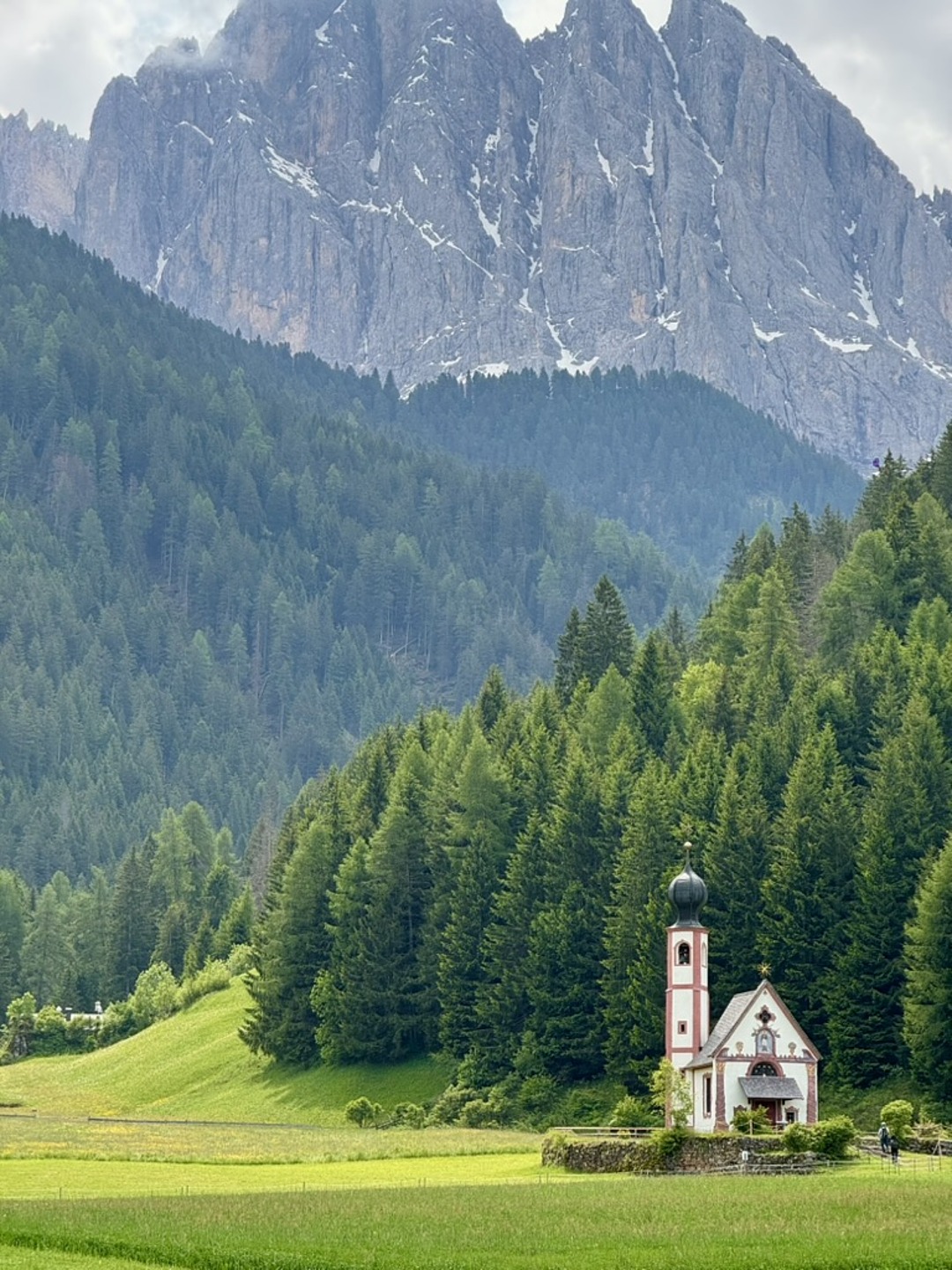
The small church of St. Magdalena, white-walled and slender-spired, set in a foreground of green meadow with the jagged Odle peaks rising behind it — this is possibly the most photographed valley in the Alps, and for good reason. But the valley itself is worth more than a photograph. Walk its trails, eat at its farms, listen to its quiet. The image everyone comes for is only the beginning.

Rifugio Scotoni

Alta Badia

A mountain hut reachable only on foot, set on a high plateau with views that stretch across the Fanes-Senes-Braies Natural Park to peaks you can’t name and don’t need to. The canederli are handmade, the speck is local, and the wine list is short and considered. You eat outside on wooden benches, and every bite tastes better for the walk that earned it. This is what mountain dining was always supposed to be.

Restaurant St. Hubertus

San Cassiano

Norbert Niederkofler’s three-Michelin-star restaurant inside the Hotel Rosa Alpina is a temple of alpine cuisine — radical in its simplicity, uncompromising in its sourcing. Every ingredient is local. Every dish tells a story of altitude and season. The tasting menu is a journey through the mountains rendered in flavour: fermented, smoked, preserved, raw. It is fine dining that has remembered where it comes from.

Gasthof Zu Tschötsch

Bressanone

A traditional Tyrolean Gasthaus on the hillside above Bressanone, with a vine-covered terrace and views down into the valley. The wine comes from the slopes below. The schlutzkrapfen — half-moon pasta filled with spinach and ricotta — has been made the same way for decades, and tastes the way tradition should: unhurried, honest, and entirely without pretension. Order a carafe of Sylvaner and stay longer than you planned.

Malga Gostner Schwaige

Alpe di Siusi

A high-altitude malga on the Alpe di Siusi plateau, serving fresh cheese, cured meats, and dark bread on wooden boards, with a panorama that takes in the Sassolungo and the Sciliar. The walk up is part of the meal — forty minutes through meadow and forest, arriving hungry and windswept to a table in the sun. Everything is made here or sourced from the farms below. The simplicity is the luxury.

Do

  • Stay in a family-run Gasthaus rather than a big resort — the hospitality is warmer, the breakfast better, the stories longer
  • Walk to at least one rifugio for lunch — it changes the meal entirely
  • Learn three words of Ladin — the locals will love you for it
  • Drive the Sella Pass at sunset when the rocks turn pink and the road empties out
  • Visit in September when the summer crowds are gone and the larch trees turn gold

Don’t

  • Try to see everything — pick one valley and go deep
  • Drive to Lago di Braies after 8am in summer — the road is a car park
  • Skip the cable cars if you can walk — the journey matters more than the view
  • Underestimate mountain weather — it changes in minutes, always carry a layer
  • Rush through meals — a three-hour lunch at a rifugio is the point